Mozart’s ‘Turkish March’, also known as ‘Rondo Alla Turca’, is one of the most recognisable pieces in classical piano music. It’s fast, energetic and sounds impressive, but many of its sections are built around patterns that become much easier once you break them down.
In this guide, we’ll take you through ‘Turkish March’ step by step, with practical tips to help you learn the notes, practise the trickier sections and gradually build up your speed.
- Watch ‘Turkish March’ played on piano
- Learning the right hand melody
- Learn the left-hand part
- Tips for learning Mozart’s 'Rondo Alla Turca'
- Learn 'Turkish March' and more
- FAQs: Turkish March by Mozart
- About the author
‘Turkish March’ is actually the third movement of Mozart’s Piano Sonata No. 11 in A major, K. 331. It can be tricky to play at full speed, especially the faster right-hand sections, but don’t let that put you off. There are plenty of repeating patterns in the piece, and once you break them down into shorter sections, they become much easier to learn.
Watch ‘Turkish March’ played on piano
First, take a look at the full piece played in Artie (our piano app) below.
Follow the falling notes to see what each hand is playing and get a feel for the rhythm, tempo and melody before you start learning it yourself.
Learning the right hand melody
If you’re learning ‘Turkish March’ on piano, I recommend starting with the right-hand melody and breaking it down into short phrases. It’s much easier to get the notes and fingering under your fingers this way than trying to tackle the whole melody at once.
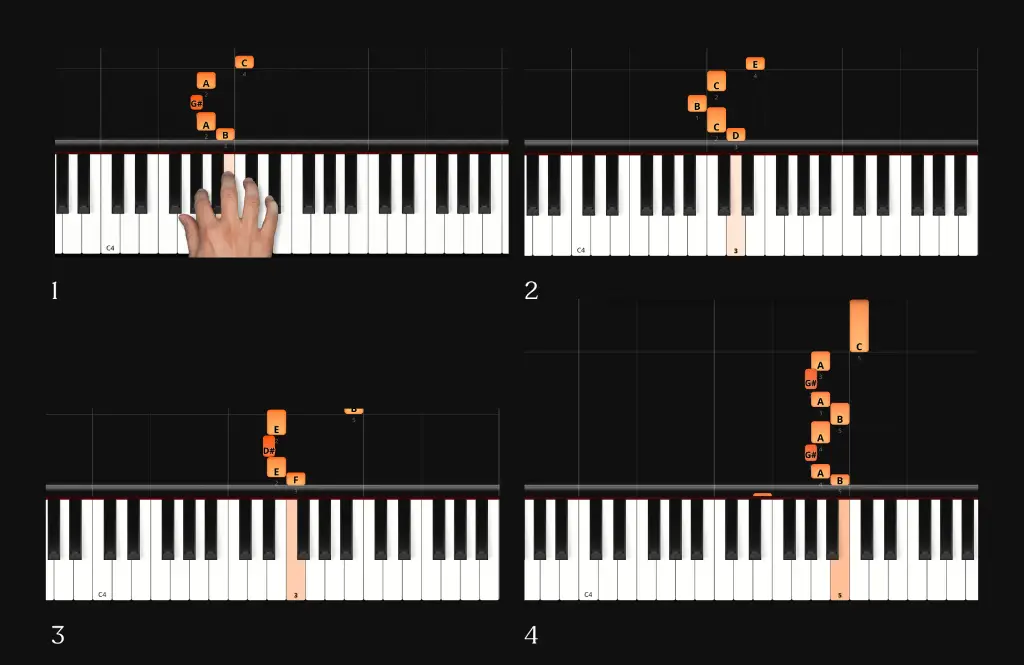
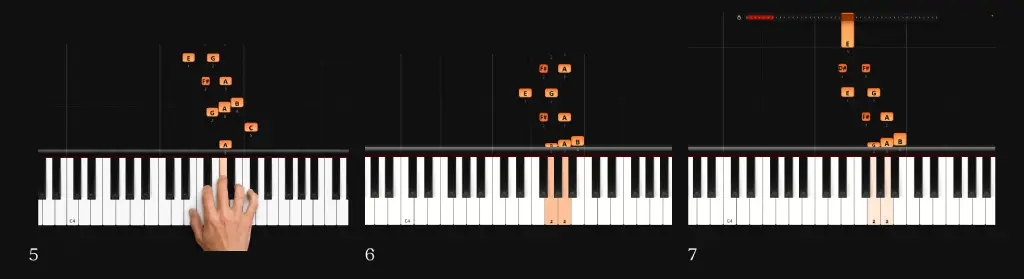
The images below show the Turkish March notes for the right hand, split into manageable sections.
Start the first phrase with your middle finger on B, moving down through your fingers and up to C with your fourth finger. Keep the notes even and play at a steady tempo. Repeat the phrase until it feels comfortable, then move your hand up and work on the next one.
Once you can play each phrase comfortably on its own, start joining them together to build up the full melody.
💡 ARTMASTER TIP: If a phrase is giving you trouble, don’t rush it. In Artie, you can loop the section, slow the tempo down, or switch on Wait Mode so the music pauses until you play the right note. Once the phrase feels comfortable, bring it back up to speed and move on.
Learn the left-hand part
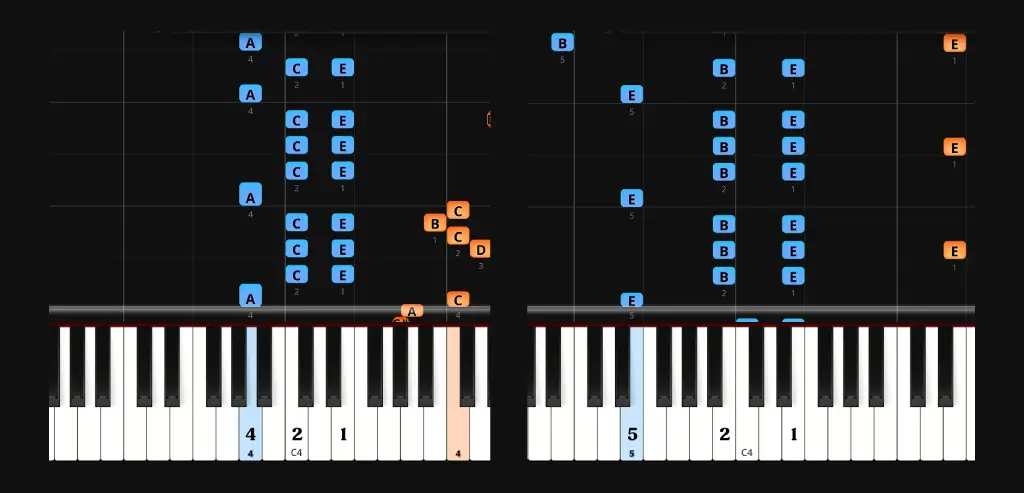
The left hand is much simpler than the melody. Under the opening section, you’re mainly moving between two patterns: A–C–E and E–D–E.
Start by practising each pattern on its own, keeping the notes even and your hand relaxed. Then practise moving between the two without looking down at your hands.
Put both hands together
Once both parts feel comfortable on their own, start putting them together. The key here is getting the A–C–E and E–D–E patterns to line up with the right-hand melody, rather than worrying about speed.
Start with the first phrase and play it slowly with both hands. Pay attention to which notes land together and repeat it until the movement feels natural. Then move on to the next phrase, before joining them together to play the complete opening.
Tips for learning Mozart’s 'Rondo Alla Turca'
1. Don’t chase the speed
‘Turkish March’ sounds impressive at full speed, but getting the notes cleanly under your fingers should come first.
Start each phrase slowly enough to play the notes and fingering correctly
Keep the tempo steady rather than speeding up through the easier parts
Once you can play a phrase cleanly three times in a row, increase the tempo a little
2. Stick to the fingering
Consistent fingering makes the fast right-hand passages much easier to play as you start building up speed.
Use the same fingers each time you practise a phrase
Pay particular attention to where your hand needs to shift position
If a passage starts falling apart as you speed up, check the fingering before slowing it down again
3. Keep it light and controlled
The faster passages are much harder to play if your hands and fingers are tense.
Keep your hand relaxed and your fingers close to the keys
Aim for crisp, even notes rather than pressing heavily into the keyboard
Keep the left hand lighter so the right-hand melody comes through clearly
💡 Try this in Artie: Choose one of the trickier phrases, loop it and bring the tempo down until you can play it cleanly three times in a row. Then increase the speed slightly and repeat.
Learn 'Turkish March' and more
🎹 Artie is the first AI piano teacher of its kind.
No sheet music, no complicated theory - just the music.
✓ Real-time feedback as you play
✓ Practice tools like loop, tempo control & wait mode
👉 Start learning with Artie for free
More to explore
Want to keep learning? Check out some more of our guides:
FAQs: Turkish March by Mozart
Is Turkish March suitable for beginners?
Turkish March is challenging for complete beginners at full speed, but you can start learning it by breaking the piece into short phrases and practising slowly. Learn each hand separately before putting both hands together.
What is the real name of Mozart’s Turkish March?
The piece commonly known as Turkish March is ‘Rondo Alla Turca’, the third movement of Mozart’s Piano Sonata No. 11 in A major, K. 331.
How long does it take to learn Turkish March on piano?
It depends on your experience. A beginner may be able to learn the main melody relatively quickly, but playing the complete piece accurately at full tempo can take several weeks or longer.
What is the hardest part of Turkish March?
For many learners, the biggest challenge is playing the fast right-hand passages evenly while keeping the correct fingering. Practising these passages slowly in short sections makes them much easier to learn.
How can I practise Turkish March faster?
Start well below the final tempo and only increase the speed when you can play a section cleanly. Looping short phrases is usually more effective than repeatedly playing the entire piece from beginning to end.
Can I learn Turkish March without reading sheet music?
Yes. You can learn Turkish March using falling-note tutorials and visual note guides, or practise it in Artie, where you can slow the piece down, loop sections and use Wait Mode while you learn.
About the author
Matt Ford is a musician, music educator and writer with over 30 years of experience playing and making music. He writes practical music-learning guides for ArtMaster, drawing on his background in music education, performance and music technology.