Learning the piano intro to Clocks by Coldplay is one of those moments where the piano suddenly feels cinematic.
You play a few repeating notes, the rhythm starts moving, and suddenly it sounds like the beginning of a stadium-sized song. Not bad for a riff that is basically built from a few repeating shapes.
The good news? Clocks is easier than it sounds.
The bad news? It only works if the rhythm flows. If you play the notes stiffly, it loses that hypnotic Coldplay feeling almost immediately.
In this guide, we’ll break down the Clocks piano notes, the right-hand riff, the left-hand bass pattern, the easiest way to practise it, and how to use Artie to see the notes visually as you play.
- Quick answer: how do you play Clocks on piano?
- Watch the Clocks piano intro in Artie
- How to play the right hand riff of Clocks on piano
- Adding the piano bass line
- Learn Clocks with Artie
- Common mistakes when learning Clocks on piano
- What's next?
- More piano tips to explore
- FAQs: Playing Clocks on piano
- About the author
Quick answer: how do you play Clocks on piano?
The Clocks intro is basically four repeating right-hand shapes:
D# – A# – G / C# – A# – F / C# – A# – F / C – G# – F
Under that, the left hand plays:
D# → A# → A# → F
That’s the simple version. The real trick is not finding the notes. It’s getting the rhythm to roll properly, so start with the right hand, keep it slow, then add the left hand once it stops feeling like a puzzle.
In the video below, you can see the full intro being played in Artie, with the falling notes showing how the pattern moves across the keyboard. This is where it starts to make more sense visually.
Watch the Clocks piano intro in Artie
Here’s how the intro looks in Artie, our AI piano teacher. The falling notes show the right-hand riff and left-hand bass together, so you can see how the whole pattern fits.
Once you’ve practised both hands separately, try playing along.
How to play the right hand riff of Clocks on piano
The intro to Clocks is made from four repeating patterns. Each one is eight notes long, and they all follow the same rolling rhythm. Once you’ve got the four under your fingers, you just loop them endlessly.
Pattern 1: D# – A# – G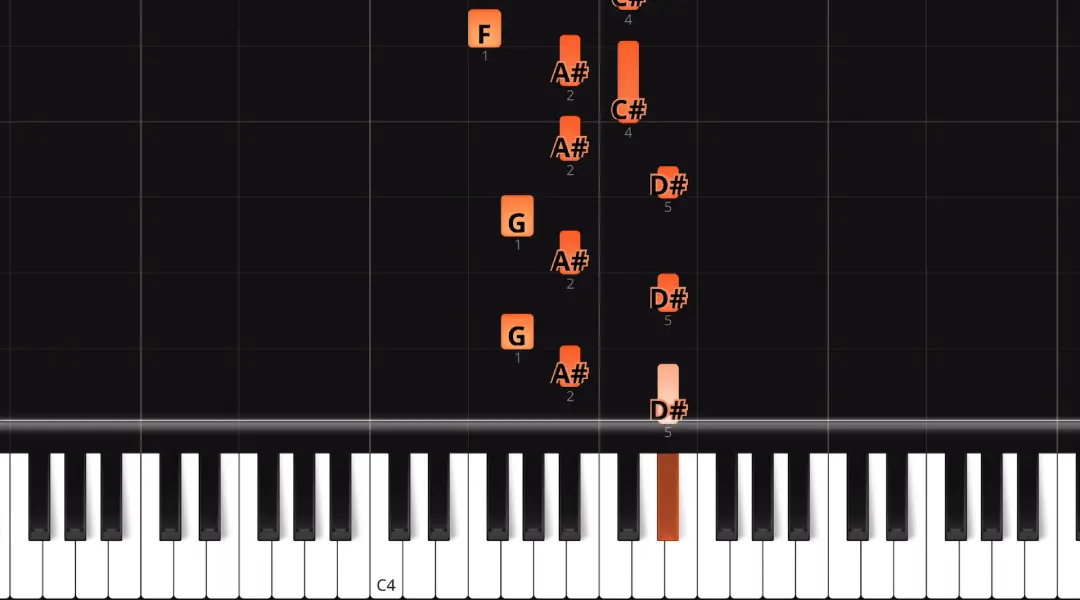
Fingering: 5 (pinky) – 2 (index) – 1 (thumb)
Sequence: 5-2-1-5-2-1-5-2
Notes: D# (5), A# (2), G (1)
This is the starting shape and the sound everyone recognises. Keep it steady — 8 even notes. When you’re first getting started, it’s a good idea to just repeat this pattern several times until it feels natural.
Patterns 2 + 3: C# – A# – F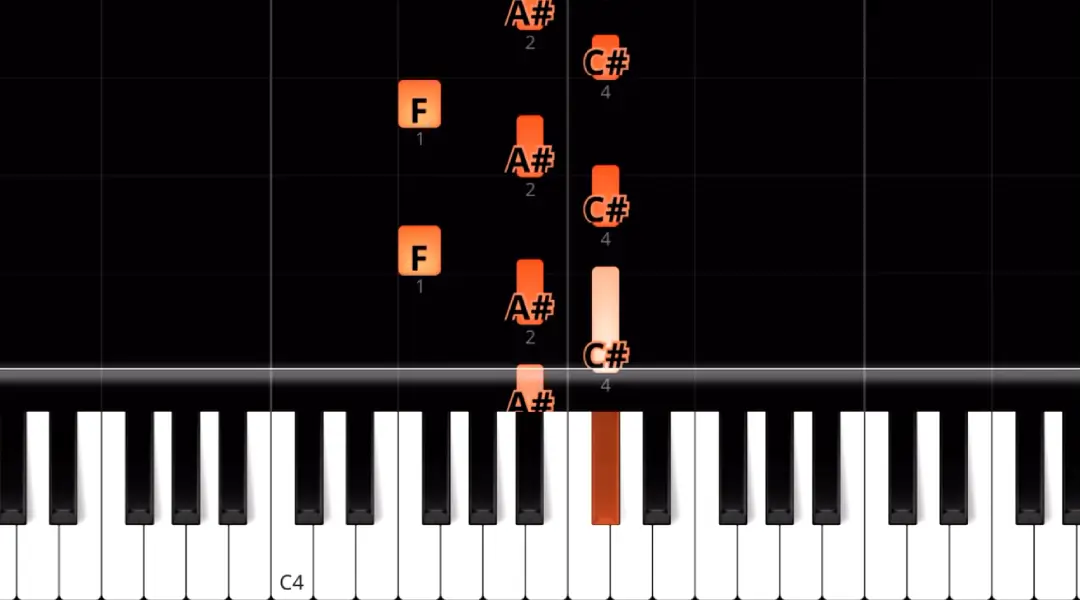
Fingering: 4 (ring) – 2 (index) – 1 (thumb)
Sequence: 4-2-1-4-2-1-4-2
Notes: C# (4), A# (2), F (1)
The top note drops to C#, the bottom drops to F, while your index stays anchored on A#. This shape repeats twice — it’s what gives the riff its rolling, hypnotic feel.
Pattern 4: C – G# – F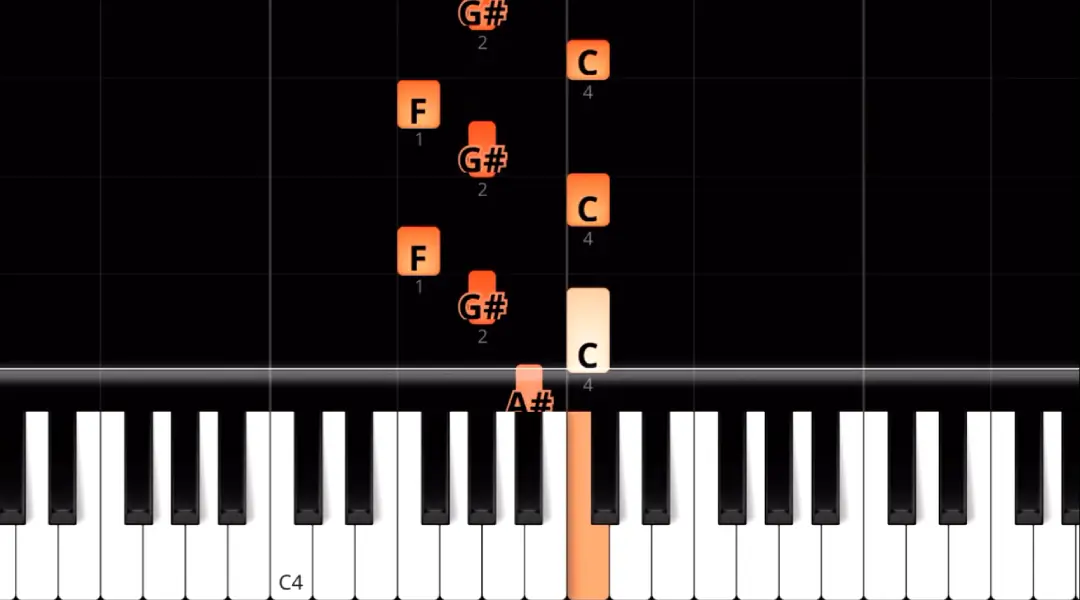
Fingering: 4 (ring) – 2 (index) – 1 (thumb)
Sequence: 4-2-1-4-2-1-4-2
Notes: C (4), G# (2), F (1)
Here the 4th and 2nd fingers move down to C and G#, while your thumb stays on F. This closes the loop and leads you back to Pattern 1.
Putting it together
Play the patterns in order:
Pattern 1 → Pattern 2 → Pattern 3 → Pattern 4 → back to Pattern 1.
That’s the complete right-hand loop of Clocks. Once it clicks, the riff will roll on almost automatically.
Adding the piano bass line
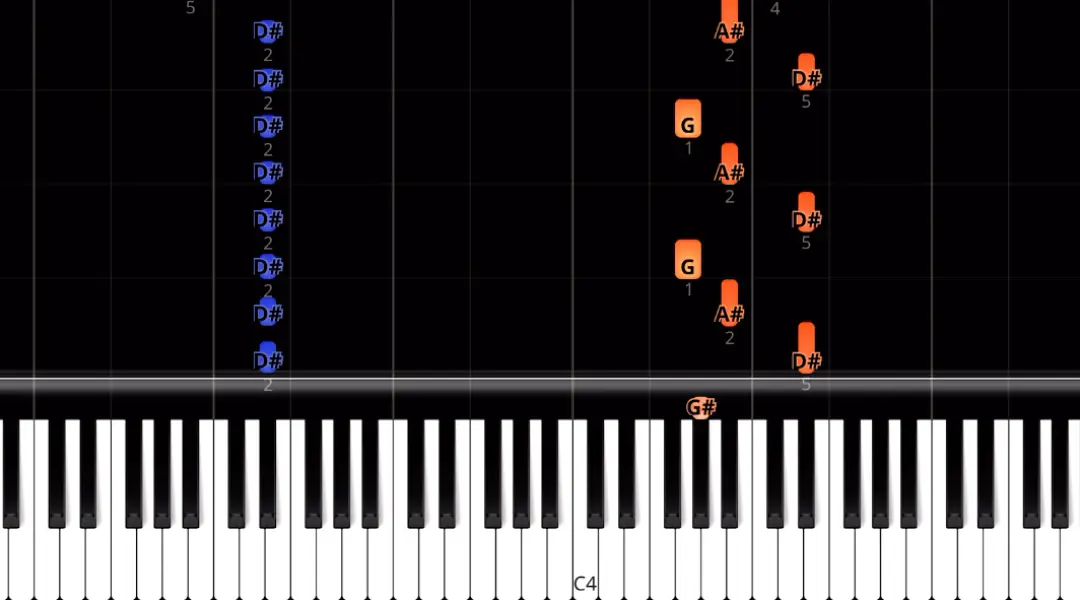 The bass line is just four notes on repeat:
D# → A# → A# → F
Here’s the simplest and most comfortable way to finger it:
D# = 2 (index finger)
A# = 5 (pinky)
F = 1 (thumb)
In this simplified version, keep the left hand steady underneath the right-hand pattern. Start by holding or repeating each bass note slowly, then follow the timing shown in Artie once both hands feel comfortable.
That’s all there is to it — four notes looping over and over.
Learn Clocks with Artie
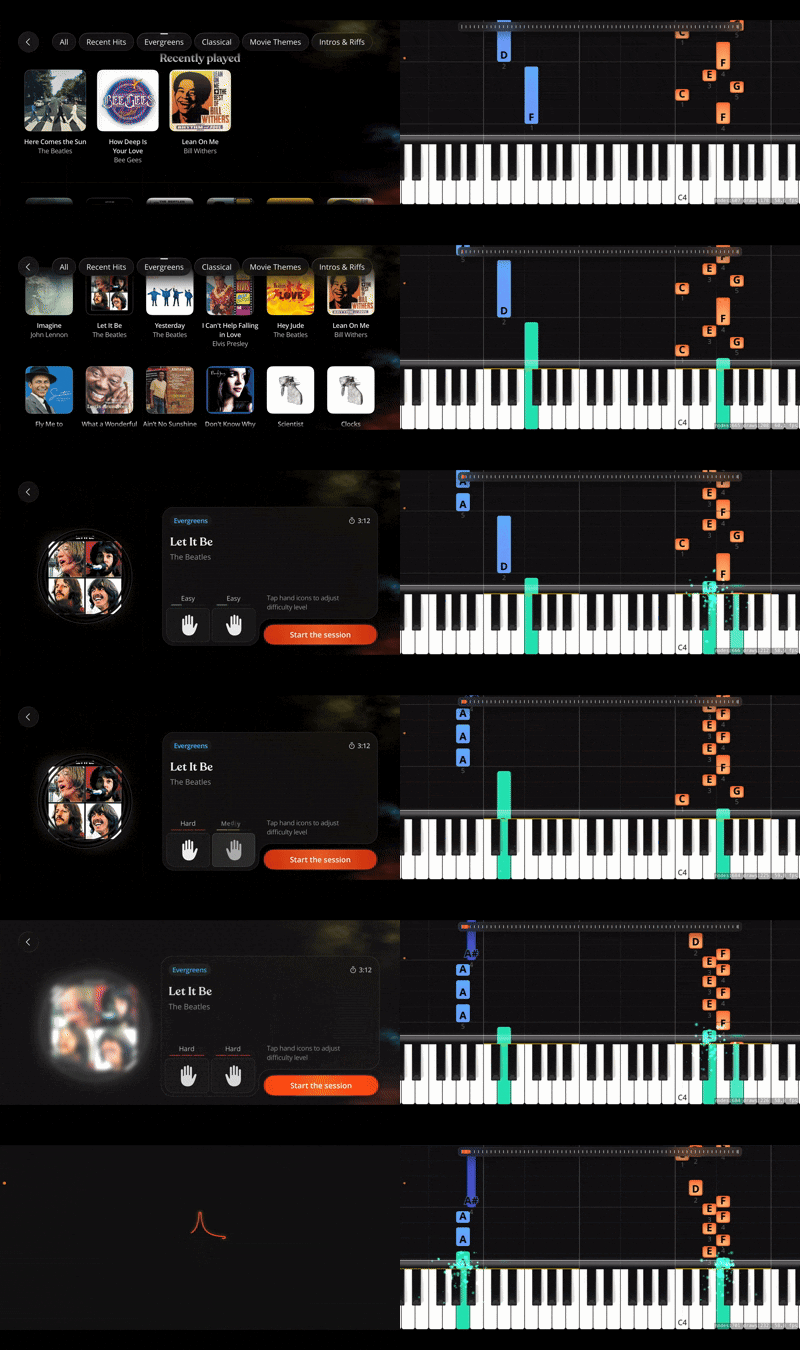 Clocks is exactly the kind of riff that makes more sense when you can see it. In Artie, the falling notes show where the right hand moves, where the left hand comes in, and how the rhythm fits together.
You can slow it down, loop the tricky part, practise one hand at a time, and use Wait Mode so the song waits for you before moving on.
Try Artie on the App Store and start learning Clocks with falling notes, loop, tempo control and Wait Mode.
Want a closer look at how Artie works?
I’ve also written a full Artie piano app review, where I look at what it’s actually like to learn with the app, who it’s best for, and where it still feels like a new kind of piano-learning tool rather than a traditional lesson.
Common mistakes when learning Clocks on piano
The first mistake is rushing. The riff only works if the rhythm rolls evenly, so keep it slower than you think at first.
The second mistake is adding the left hand too early. If the right hand still feels a bit off, both hands together will probably fall apart.
The third mistake is playing every note too heavily. Clocks should move. Keep your hand loose and let the pattern flow.
What's next?
Once you’ve nailed the intro riff and bass, you don’t have to stop there. Two easy ways to make it sound bigger and closer to the full song:
Mirror the riff with the left hand. Put your left hand one octave below the right and play the same patterns for 2 cycles. It gives the riff more depth and makes it feel like Coldplay’s layered sound.
Add octaves in the bass. When you’re ready, play the bass notes as octaves — thumb on the higher note, pinky on the lower one. It adds power and makes the whole part feel more dramatic.
You can practise both of these in Artie, with the falling notes showing you exactly how they fit.
More piano tips to explore
Want to keep learning? Try these popular piano articles next:
FAQs: Playing Clocks on piano
What are the piano notes for Clocks by Coldplay?
The main right-hand notes for the Clocks intro are D# – A# – G, C# – A# – F, C# – A# – F, and C – G# – F. The left hand plays D# → A# → A# → F underneath.
Is Clocks easy to play on piano?
Clocks is easier than it sounds, but it still takes a bit of control. The notes are fairly simple. The hard part is keeping the right-hand pattern smooth and steady while the left hand plays underneath.
Can beginners play Clocks on piano?
Yes. Beginners can learn a simplified version of the Clocks intro because it is built from repeating three-note shapes. Start with the right hand only, then add the left hand once the rhythm feels natural.
Do I need to read sheet music to learn Clocks?
No. You can learn Clocks from note names, finger patterns, video, or Artie’s falling-note visuals. Sheet music can help later, but you do not need it to start learning the riff.
What is the hardest part of playing Clocks on piano?
The hardest part is not finding the notes. It is getting the rhythm to roll properly. If the right hand sounds stiff, slow it down and practise the pattern until it flows.
Can I play Clocks on a keyboard?
Yes. You can play Clocks on a keyboard or digital piano. A touch-sensitive keyboard will feel better, but you can still learn the basic intro on a smaller keyboard.
How should I practise the Clocks piano riff?
Practise the right hand first, one pattern at a time. Then connect the full right-hand loop slowly. Once that feels comfortable, add the left-hand bass notes and build up speed gradually.
Can Artie help me learn Clocks?
Yes. Artie shows the Clocks piano intro with falling notes, so you can see the rhythm and hand positions clearly. You can slow it down, loop tricky parts, practise one hand at a time, and use Wait Mode so the song waits for you before moving on.
About the author
Matt Ford is a musician, music teacher and writer based in Prague. He has played in bands for more than 30 years and studied sound engineering and music technology.
For ArtMaster, he writes about piano, guitar, singing, music production and the changing world of online music education. His work is shaped by both sides of learning music: the joy of playing, and the frustration of trying to practise when the method does not quite fit the person.