

Piano chords are the foundation of modern music across every genre. The good news is that you don't need to learn hundreds of them before you can start playing.
Get a few basic major and minor triads under your fingers and you'll already have the makings of a surprising number of songs. This guide covers all the essential piano chords, from basic triads to 7th and suspended chords, with clear diagrams, practical tips and common chord progressions.
- What is a chord?
- Basics: Major & minor chords
- Major and minor chords
- 7th chords on the piano
- Diminished & augmented piano chords
- Suspended (Sus) and Add chords
- Piano chord progressions
- How to play piano chords as a beginner
- How to practice piano chords
- Learn your first song
- FAQs about piano chords
What is a chord?
A chord is a group of notes played together. Most of the basic piano chords you'll come across are triads, made up of three notes: a root, a third and a fifth.
Change the intervals between those notes and you get different types of chord, including major, minor, diminished and augmented chords.
Basics: Major & minor chords
Major chords on piano
Major chords are the backbone of most music. They are often described as happy-sounding and are built on the 1st, 3rd, and 5th notes of a major scale.
For example, the C major chord consists of the notes C, E, and G.
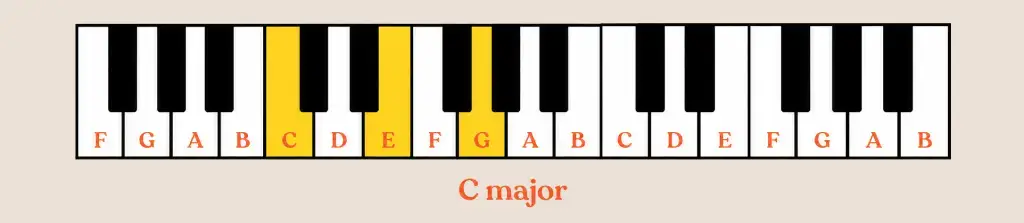
Major Chord Formula: Root, Major 3rd, Perfect 5th (1 - 3 - 5)
Example Major Chords:
C major: C - E - G
D major: D - F# - A
G major: G - B - D
Minor chords on piano
Minor chords provide a sad or melancholic feel, and are just as essential as major chords. These chords lower the 3rd note by a half-step, creating a more somber sound.
For instance, the C minor chord consists of the notes C, E♭, and G.
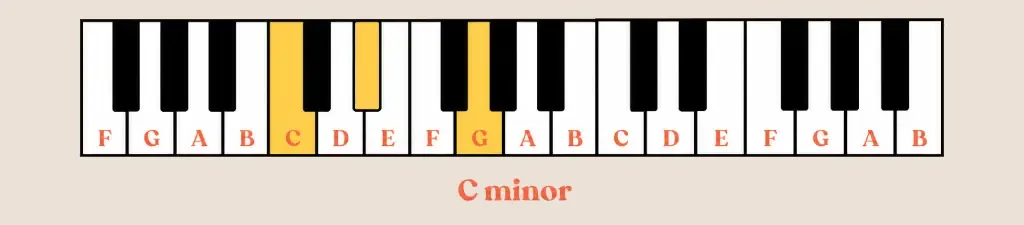
Minor Chord Formula: Root, Minor 3rd, Perfect 5th (1 - ♭3 - 5)
Example Minor Chords:
C minor: C - E♭ - G
D minor: D - F - A
E minor: E - G - B
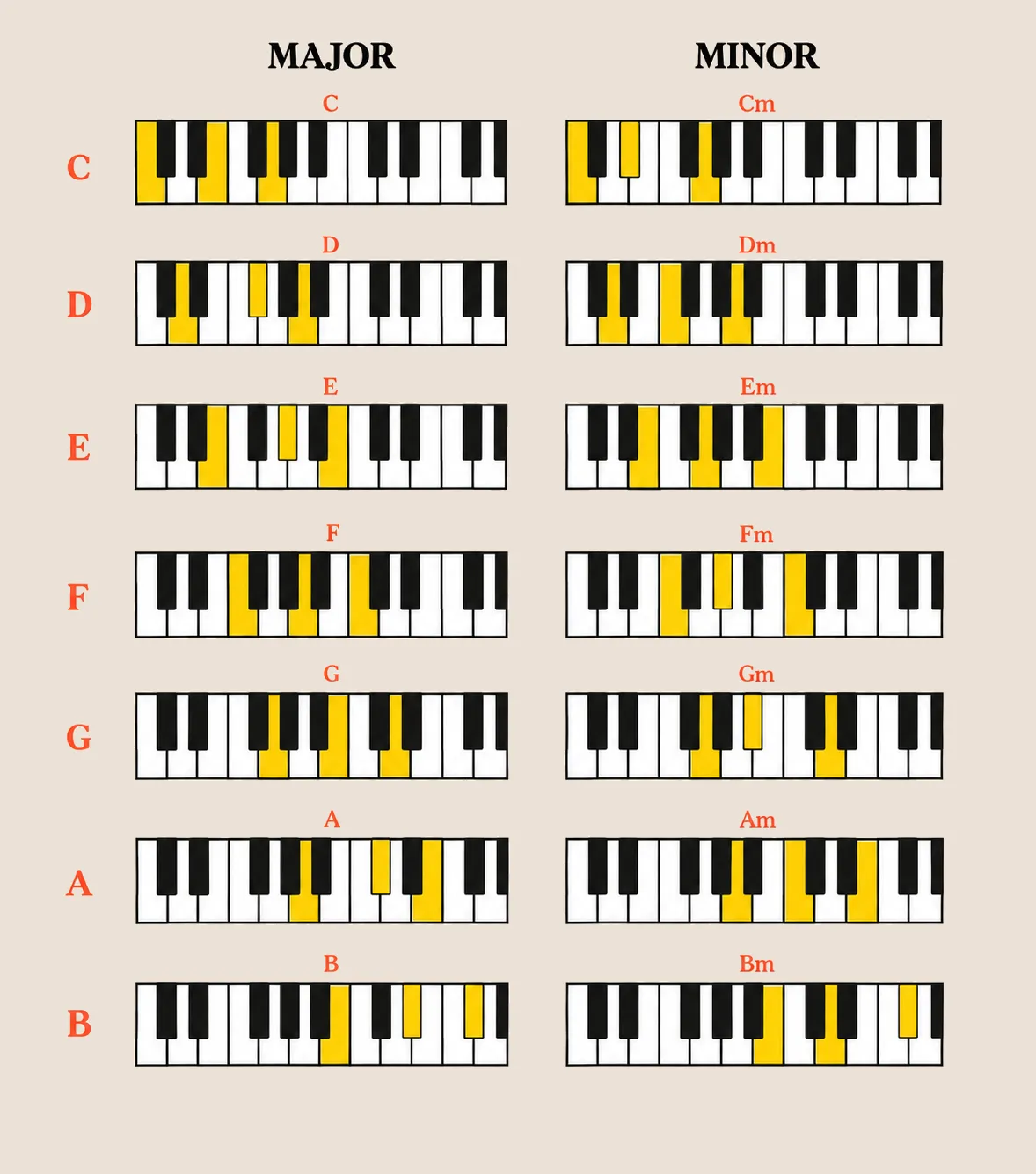
Basic major and minor chords for beginners
 💡 ARTMASTER TIP: If you are learning the piano from scratch, our piano guide for beginner's covers the basics from learning the names of the piano keys to playing your first melody.
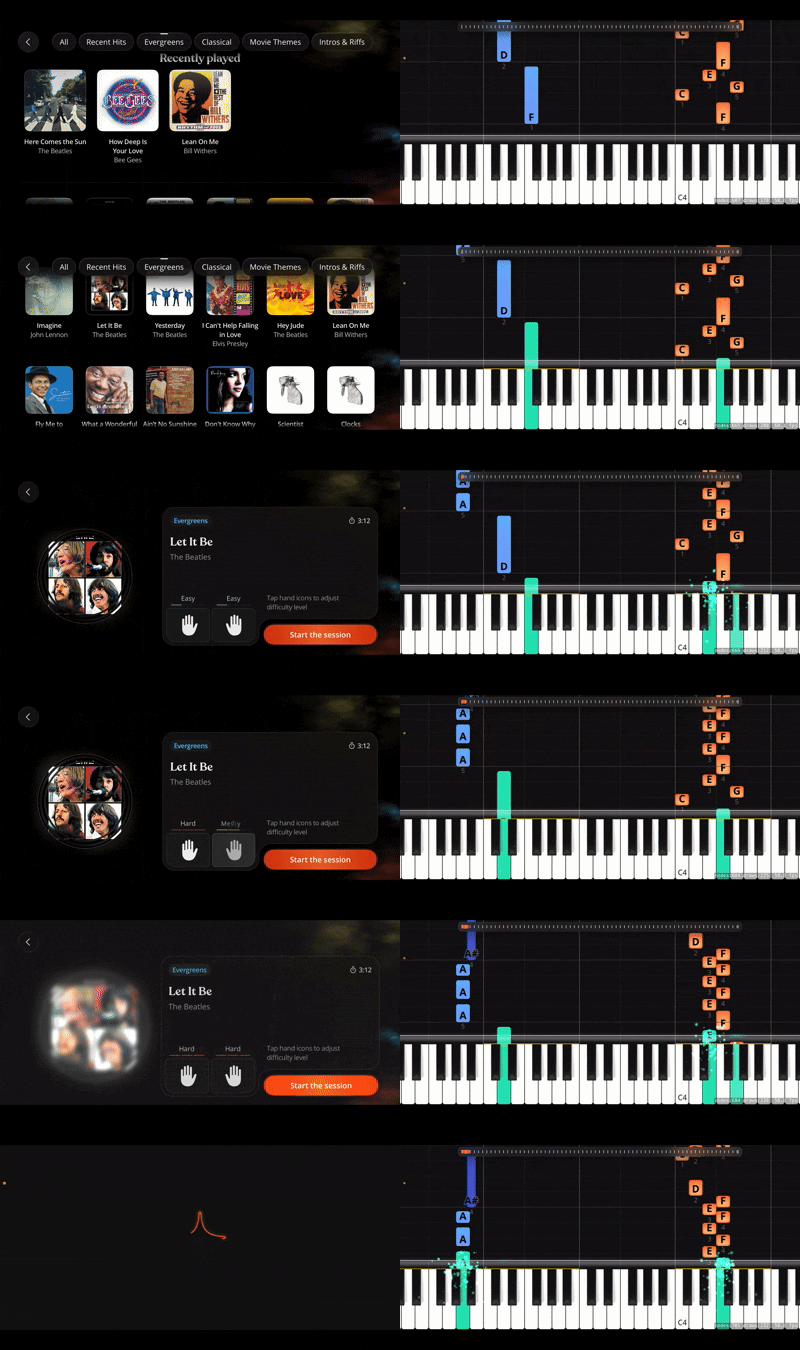
💡 Real feedback. Real progress. Meet Artie.
Artie is the world’s first AI piano learning app that actually listens to your playing and gives real-time feedback to help you improve faster.
Major and minor chords
Here are the notes in the 12 major and 12 minor piano chords:
Major chord | Notes | Minor chord | Notes |
|---|---|---|---|
C | C–E–G | Cm | C–E♭–G |
C♯ / D♭ | C♯–E♯–G♯ | C♯m / D♭m | C♯–E–G♯ |
D | D–F♯–A | Dm | D–F–A |
E♭ | E♭–G–B♭ | E♭m | E♭–G♭–B♭ |
E | E–G♯–B | Em | E–G–B |
F | F–A–C | Fm | F–A♭–C |
F♯ / G♭ | F♯–A♯–C♯ | F♯m / G♭m | F♯–A–C♯ |
G | G–B–D | Gm | G–B♭–D |
A♭ | A♭–C–E♭ | A♭m | A♭–C♭–E♭ |
A | A–C♯–E | Am | A–C–E |
B♭ | B♭–D–F | B♭m | B♭–D♭–F |
B | B–D♯–F♯ | Bm | B–D–F♯ |
7th chords on the piano
Seventh chords add depth and complexity to your playing. They are built by adding a 7th interval to a basic triad.
Major 7th piano chords
Major 7th chords have a dreamy, jazzy sound. They consist of a major triad with an added major seventh interval.
Major 7th Chord Formula: Root, Major 3rd, Perfect 5th, Major 7th (1 - 3 - 5 - 7)
Example Major 7th Chords:
Cmaj7: C - E - G - B

Fmaj7: F - A - C - E
Gmaj7: G - B - D - F#
Dominant 7th piano chords
Dominant 7th chords are essential in blues and jazz. These chords have a flattened 7th, adding tension to the music.
Dominant 7th Chord Formula: Root, Major 3rd, Perfect 5th, Minor 7th (1 - 3 - 5 - ♭7)
Example Dominant 7th Chords:
C7: C - E - G - B♭

D7: D - F# - A - C
Minor 7th piano chords
Minor 7th chords combine a minor triad with a minor seventh, resulting in a rich, mellow sound.
Minor 7th Chord Formula: Root, Minor 3rd, Perfect 5th, Minor 7th (1 - ♭3 - 5 - ♭7)
Example Minor 7th Chords:
Cm7: C - E♭ - G - B♭

Dm7: D - F - A - C
Diminished & augmented piano chords
Diminished piano chords
Diminished chords are built by lowering both the 3rd and 5th notes of a major triad, giving them a dissonant, tense sound.
Diminished Chord Formula: Root, Minor 3rd, Diminished 5th (1 - ♭3 - ♭5)
Example Diminished Chords:
Cdim: C - E♭ - G♭

Edim: E - G - B♭
Augmented piano chords
Augmented chords, on the other hand, sound more expansive and “wider.” They raise the 5th note by a half-step.
Augmented Chord Formula: Root, Major 3rd, Augmented 5th (1 - 3 - #5)
Example Augmented Chords:
Caug: C - E - G#

Gaug: G - B - D#
Suspended (Sus) and Add chords
Suspended piano chords (Sus2 and Sus4)
Suspended chords replace the 3rd note of a chord with either the 2nd or 4th note, creating a sense of unresolved tension. These are great for building drama in music.
Sus2 Formula: Root, Major 2nd, Perfect 5th (1 - 2 - 5)
Sus4 Formula: Root, Perfect 4th, Perfect 5th (1 - 4 - 5)
Example Suspended Chords:
Csus2: C - D - G

Csus4: C - F - G

Add piano chords
Add chords are similar to triads, but with an added note (usually the 9th). Unlike 7th chords, they don’t extend the chord beyond a simple triad.
Add9 Formula: Root, Major 3rd, Perfect 5th, Major 9th (1 - 3 - 5 - 9)
Example Add Chords:
Cadd9: C - E - G - D

Piano chord progressions
Chords aren’t just played individually — they’re used in progressions to create the structure of a song. One of the most popular chord progressions is the I-IV-V progression, commonly used in pop, rock, and blues.
Common chord progressions:
I-IV-V (C-F-G): Used in countless songs for a bright, strong feel.
ii-V-I (Dm-G-C): Popular in jazz, this progression resolves nicely to the tonic chord.
I-V-vi-IV (C-G-Am-F): This is the “four-chord progression” behind many modern pop songs.
💡ARTMASTER TIP: Want to try these progressions in real songs? Check out our step-by-step guides: 25 easy 2-chord songs, 60 easy 3-chord songs, and 100 easy 4-chord songs. Each one includes piano chord diagrams to help you get playing right away.
How to play piano chords as a beginner
If you're new to piano chords, don’t worry — you don’t need to know any music theory to get started. Just follow these simple steps and you’ll be playing real chords in no time.
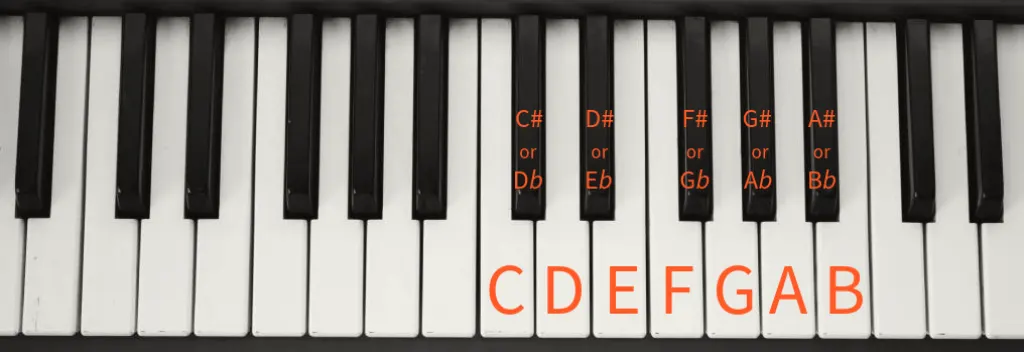
1. Learn the layout of the piano keys
Start by finding middle C — it’s the white key just to the left of the group of two black keys near the centre of your keyboard. From there, get to know the white notes: C, D, E, F, G, A, B (find more beginner tips here)
2. Play your first major chord
Place your thumb on C, your middle finger on E, and your pinky on G. Press all three together — that’s a C major chord, made from the 1st, 3rd, and 5th notes of the C major scale. This is called a triad.
3. Try a minor chord
Now move to A minor — play A, C, and E together. It’s similar in shape, but has a darker, more melancholic sound. That’s the effect of the minor third interval.
4. Practise switching between chords
Try moving between C major, F major, and G major. These form a classic chord progression (I–IV–V) used in countless songs. Take it slowly at first — focus on playing each chord cleanly.
5. Explore 7th chords and other variations
Once you're confident with basic triads, try more advanced chords like Cmaj7 (C–E–G–B) or C7 (C–E–G–B♭). These add depth and emotion to your sound, especially in jazz or blues.
6. Use chords in real songs
The best way to learn chords is to use them in songs. Start with our easy guides:
Each one includes piano chord diagrams so you can follow along without reading sheet music.
How to practice piano chords
Here are a few tips for getting comfortable with piano chords:
Start slow: Focus on basic major and minor chords before moving to more complex ones.
Use inversions: Learn to play chords in different inversions (e.g., C major: C-E-G, E-G-C, G-C-E).
Practice with progressions: Try common progressions like I-IV-V to build fluidity between chords.
Explore different genres: Chords are used in all types of music, from classical to blues and jazz. Experiment with 7th chords, diminished chords, and more as you explore new genres.
💡ARTMASTER TIP: Find out more about the art of effective music practice.
Learn your first song
Looking to start playing songs on the piano? David Bennett’s Piano for Beginners course at ArtMaster.com is the perfect place to begin.
With experience teaching hundreds of thousands on his YouTube channel (1M+ subs), David now brings that same energy to ArtMaster. His course is designed to help you play your first song as quickly as possible, step by step.
If you’re ready to learn some of the world’s iconic tunes, sign up your 7-day FREE trial!
FAQs about piano chords
What are the most important piano chords to learn first?
Start with C major, F major, and G major. They’re easy to play and appear in thousands of songs. Add A minor, D minor, and E minor as you progress.
How do I know which chords sound good together?
Chords from the same key usually work well together. In C major, try C, F, G, Am, Dm, and Em. The I–IV–V progression (C–F–G) is a great place to start.
What’s the difference between major and minor chords?
Major chords sound happy; minor chords sound sad. The only difference is the third note: major chords use a major third, while minor chords use a minor third.
Do I need to learn music theory to play chords?
No. You can learn chords by shape and sound, using diagrams or apps. Many beginners start playing songs with chords before learning theory.
How long does it take to get good at piano chords?
With regular practice, you can learn basic chords in a few weeks. Smooth transitions and fluency take longer but improve steadily with real song practice.
What are chord inversions, and should I learn them?
Inversions are new ways to play the same chord using a different note on the bottom. They help make your playing smoother and more connected.
About the author
Matt Ford is a musician, teacher, writer, and lifelong student of sound.
With years of experience in both performing and teaching, he shares practical advice through ArtMaster to help musicians at every level build skill and confidence in their playing.