Deciding to learn piano is a great step, no matter your age. You might be dreaming of playing your favourite piano songs, composing music, or simply want the therapeutic benefits of playing music.
These beginner piano lessons will help you get started from scratch, from learning the piano keys and playing your first melody to building confidence with simple exercises. Plus, you'll get expert piano practice tips and a free video lesson to help you get started!
- How to start playing piano from scratch
- Choosing a piano or keyboard
- Get to know the piano keyboard
- Free video tutorial on identifying piano notes
- Should you label your piano keys?
- Play your first piano melody
- How to position your hands
- Play with all five fingers
- Beginner piano exercises
- Piano practice tips to learn faster
- How long does it take to learn piano?
- Learn piano for free
- FAQ: Starting piano for beginners
How to start playing piano from scratch
Not sure where to begin?
Starting piano can feel a bit overwhelming at first, but it really doesn't have to be. You don't need to read sheet music or own an expensive piano before you can start.
These beginner piano lessons will take you through the basics step by step. You'll learn how the keyboard is laid out, how to find the notes, play your first melody and build a few good habits from the start.
Take your time, don't worry about getting everything perfect, and by the end you'll have a solid foundation to build on.
All you'll need is:
A piano or keyboard (61 keys or more is ideal)
Around 15–30 minutes to practise
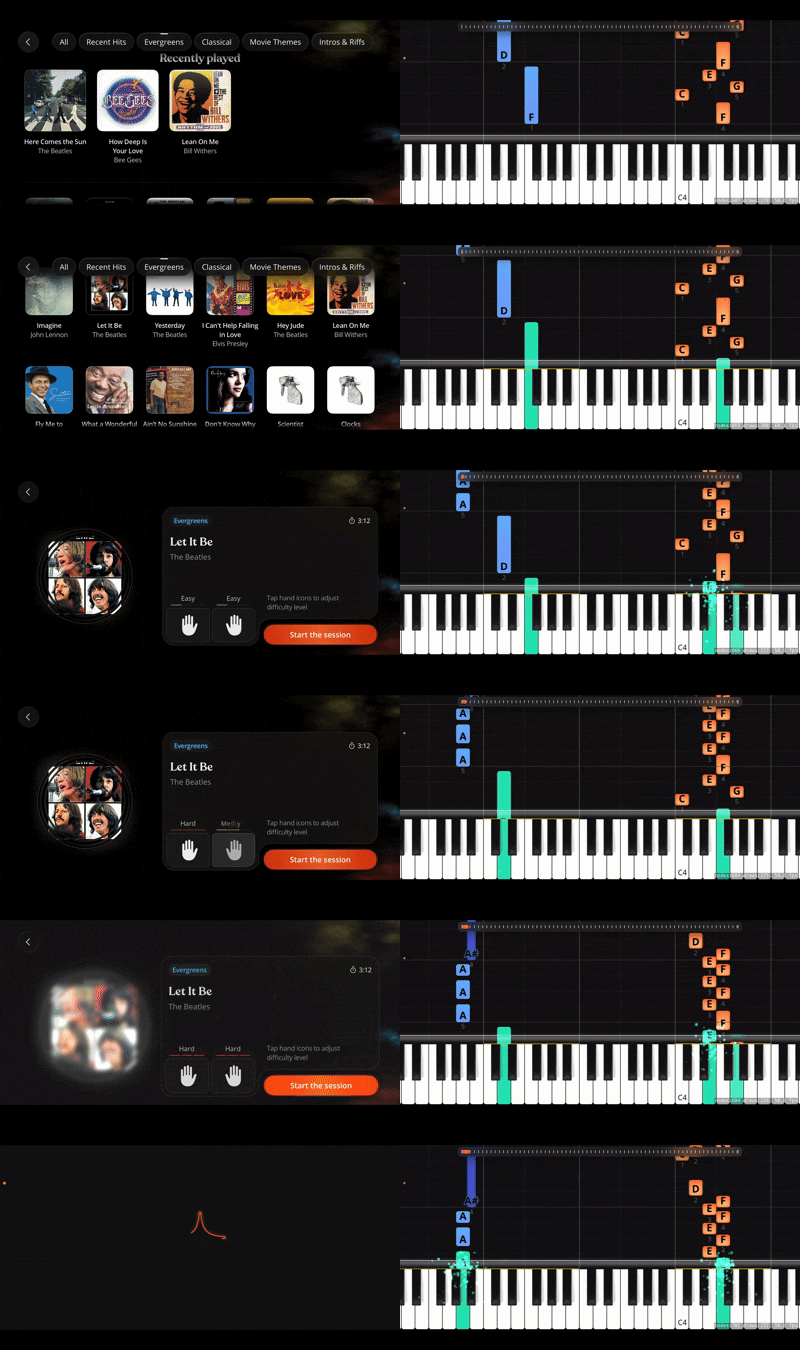
💡 ARTMASTER TIP: Learning is much easier when you get feedback while you practise. Our piano app Artie listens as you play and highlights mistakes, helping you spot problems earlier instead of only noticing them later.
Choosing a piano or keyboard
Before you start learning piano, you'll need to have an instrument. Hopefully, you already have something in front of you, anything with a keyboard will do - maybe an old electronic keyboard, a Midi keyboard plugged into a computer or even an upright piano. Make sure your instrument is set up in a well-lit, comfortable area and that your stool or chair is at the correct height to maintain proper posture.
💡 ARTMASTER TIP: If you're unsure which to choose, check out our guide, including the latest recommendations - Keyboard vs Piano: which should you choose?
Get to know the piano keyboard
Piano key names
The good news is that almost every piano and keyboard has the same layout. Once you've learnt it on one instrument, you'll be able to find the notes on almost any other.
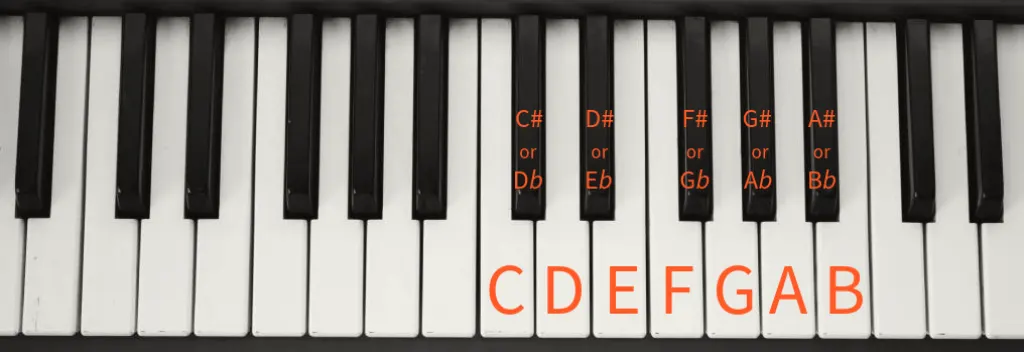
The keyboard is made up of a repeating pattern of white and black keys.
7 white keys – the notes A to G, then the pattern repeats.
5 black keys – these are the sharps (#) and flats (♭).
The easiest place to start is by finding the groups of two black keys. The white key immediately to the left is always C. Once you can spot that pattern, finding the rest of the notes becomes much easier.
Finding Middle C
Middle C is a useful starting point for many beginner songs. On an 88-key piano it's the fourth C from the left, but on most keyboards it's simply the C closest to the middle.
Free video tutorial on identifying piano notes
If you're still not completely sure where the notes are, this short lesson from David Bennett explains the keyboard layout really clearly. Spend a few minutes watching it, then come back and try finding the notes on your own keyboard.
Take your first real step toward playing piano! Join David Bennett’s beginner-friendly course and start playing real songs today. Try it free for 7 days!
Should you label your piano keys?
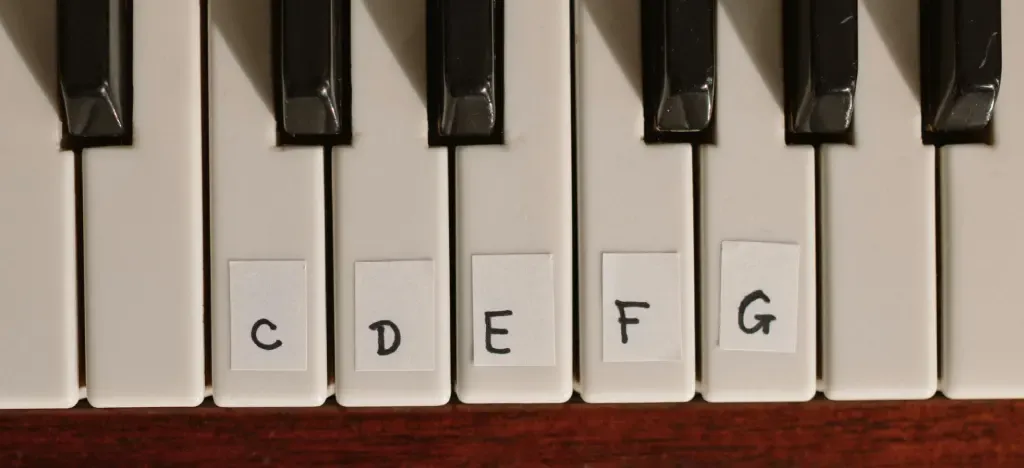
Some beginners find it helpful to label the keys while they're learning. If you decide to do it, use something temporary so you can remove it once you start recognising the notes naturally.
Some simple options include:
Sticky notes
Removable keyboard stickers
Dry-erase markers (on suitable surfaces)
Colour-coded dots
Don't worry if you decide not to label them. As long as you keep practising, you'll soon start recognising the keyboard pattern without any labels.
Play your first piano melody
Piano Letter Notes
If you can't read sheet music yet, don't worry. Piano letter notes use the letters A to G to show you which keys to play, making them an easy way to get started.
A great first melody is Twinkle Twinkle Little Star. It only uses the notes C, D, E, F, G and A, so before you begin, make sure you can find those notes on your keyboard.
For now, don't worry about using the correct fingers. Just focus on finding the right notes.
"Twinkle Twinkle Little Star" Melody
   Twin-kle  twin-kle  lit-tle  star,
   C    C    G    G    A    A    G

   How  I    won-der  what  you  are.
   F    F    E    E    D    D    C

   Up   a -  bove the world so   high,
   G    G    F    F    E    E    D

   Like a   dia-  mond in  the  sky.
   G    G    F    F    E    E    D

   Twin-kle  twin-kle  lit-tle  star,
   C    C    G    G    A    A    G

   How  I    won-der  what  you  are.
   F    F    E    E    D    D    C
Congratulations! You've played your first melody.
Play it a few more times until you can find the notes without thinking too much about them. Don't worry if it feels slow at first. Accuracy is much more important than speed.
💡 ARTMASTER TIP: This is a great place to switch to our piano app, Artie. Instead of following letter notes, you can learn Twinkle Twinkle Little Star using Wait Mode, which only moves on once you've played the correct note. Or try these one-hand piano songs.
How to position your hands
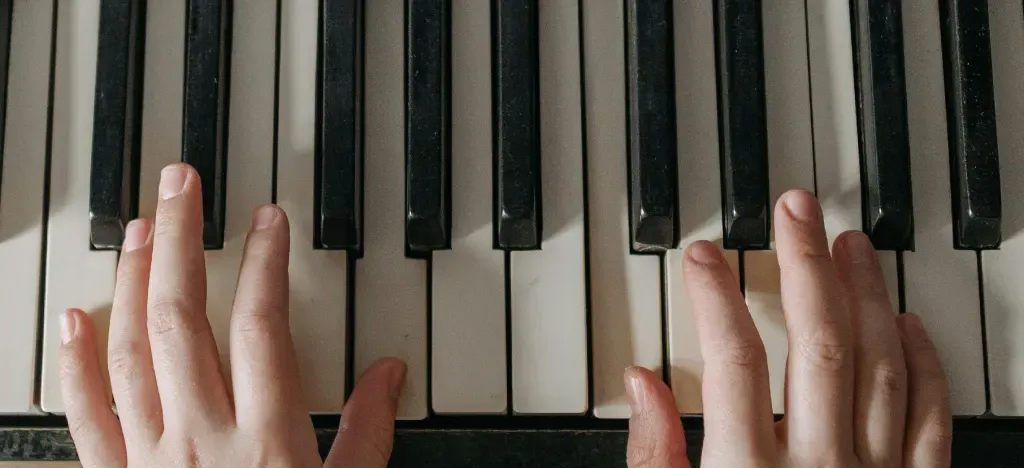
Piano hand posture
Now that you've played your first melody, it's worth spending a minute on hand position. Good technique will make playing feel more comfortable and help you avoid unnecessary tension.
Don't worry about getting everything perfect straight away. Just keep your hands relaxed and let your fingers rest naturally on the keys.
Relax your hands: Let your hands hang loosely and give them a quick shake to release any tension.
Curve your fingers: Rest your fingers on the keys as if you're gently holding a small ball.
Start with your right hand: Place your thumb on middle C, then let your other fingers rest naturally on D, E, F and G.
Keep your wrist level: Avoid letting it drop too low or lifting it too high.
Stay relaxed: If your hands or shoulders start to tense up, pause and reset before carrying on.
You don't need perfect technique straight away. Focus on staying relaxed and comfortable, and your hand position will improve naturally as you play more.
💡 ARTMASTER TIP: Good hand posture will make learning piano easier in the long run! You can learn more about hand posture in the Artie app, where you'll find guided lessons designed to help you build good technique from the start.
Play with all five fingers
"One Love" by Bob Marley
Now let's put your hand position into practice. Rest your right thumb on middle C, then let your other fingers rest naturally on D, E, F and G.
This time, try to keep your hand in the same position and use the correct finger for each note. The melody starts on E, so begin with your middle finger and play it slowly.
   One   love, one   heart,
   E     E     D     D

   Let's get to-ge-ther and feel al-right
   F     E   D  C  D    C   E    D  C

   One   love,  one   heart,
   E     E     D     D

   Give thanks and praise to the Lord
   E     F     F   F      E  D   C

   And I will feel al-right
   C   C D     E   D   C

   Let's get to-ge-ther and feel al-right
   F     E   D  C  D    C   E    D  C
Again, repeat it a few times and gradually increase your speed as you become more confident. This time, you can concentrate on keeping your hand position as relaxed as possible.
Beginner piano exercises
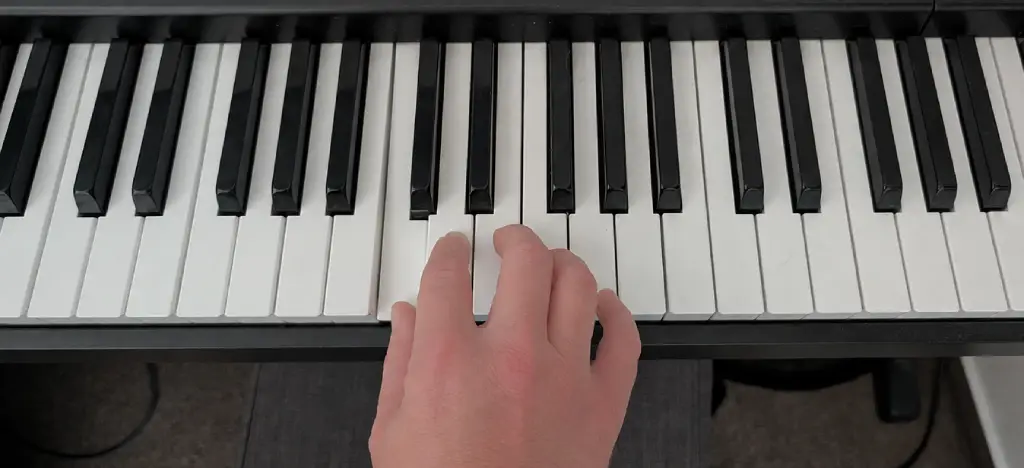
Now that you've played a couple of simple melodies, it's time to build confidence and improve your finger control. These short exercises only take a few minutes but will make playing feel much more comfortable.
Five-note exercise
Place your right thumb on middle C and play: C – D – E – F – G and then back down F – E – D – C
Play it slowly, keeping one finger on each note.
Keep a steady rhythm
Try playing the same exercise again, but this time count: 1, 2, 3, 4
Keep the notes evenly spaced. Don't worry about speed — a steady rhythm is much more important.
Repeat
Play the exercise three or four times. If your hand starts to tense up, stop, relax and start again more slowly.
Once these exercises feel comfortable, you're ready to move on to scales, chords and more challenging songs.
💡 ARTMASTER TIP: Ready for the next step? Learn your first major and minor chords in our guide: how to play piano chords.
Piano practice tips to learn faster
You don't need to practise for hours every day to make good progress. Short, focused practice sessions are usually much more effective than one long session every now and then.
A few simple habits will help you improve more quickly:
Practise little and often. Even 15–20 minutes a day is enough to build good habits.
Slow down. Playing accurately is much more important than playing fast.
Repeat the difficult bits. Spend extra time on the parts you find hardest instead of always starting from the beginning.
Set small goals. Focus on one thing each time you practise, whether that's learning a few notes, improving your rhythm or playing a melody more smoothly.
Enjoy the process. The more you enjoy practising, the more likely you are to stick with it.
💡 ARTMASTER TIP: Find out more about the art of effective music practice.
How long does it take to learn piano?
One of the first questions beginners ask is, "How long will it take before I can actually play something?"
The good news is that you'll probably be surprised how quickly you can make progress. If you practise regularly, most beginners can expect something like this:
After 1 week: Play a simple melody with one hand.
After 1 month: Play basic chords and a few beginner songs.
After 3–6 months: Play complete songs with both hands and feel much more confident at the keyboard.
Everyone learns at a different pace, so don't compare yourself to other people. The most important thing is to keep practising consistently.
💡 ARTMASTER TIP: Want to learn faster - even with a busy schedule? Read our full guide to learning piano fast for practical, no-nonsense tips that actually work.
Learn piano for free
If you've made it this far, you've already learnt more than many people do on their first day. Keep practising little and often, and you'll be surprised how quickly things start to click.
The next step is simply to keep playing.
Whether you choose a teacher, an online course or an app, the most important thing is to practise regularly and enjoy the process.
If you'd like more guidance, you can try Artie, our AI piano teacher. It listens while you play, gives you real-time feedback and guides you through songs step by step, helping you build confidence from your very first lesson.
Or, if you prefer a more traditional approach, you can also try David Bennett's excellent Piano 1 for Beginners course with a FREE 7-day Trial.
FAQ: Starting piano for beginners
Do I need a real piano to learn, or is a keyboard enough?
A keyboard is absolutely fine, especially one with full-size, touch-sensitive keys. Many beginners start with a keyboard before upgrading to a piano.
Can I learn piano without reading sheet music?
Yes. Many beginners start with letter notes, visual tutorials or apps before learning to read sheet music.
What is the easiest melody to play on piano?
Simple melodies like Twinkle Twinkle Little Star, Mary Had a Little Lamb and Hot Cross Buns are great first tunes because they use just a few notes and are easy to remember.
What is the easiest song to learn on piano?
If you're ready to move beyond simple melodies, songs with a few basic chords such as Stand By Me or Let It Be are good places to start.
How long does it take to learn piano as a beginner?
With 15–20 minutes of practice each day, many beginners can play simple melodies within a week and beginner songs within a few months.
What's the best age to start learning piano?
Any age. Children and adults can both learn successfully. Consistent practice is much more important than when you start.
What's the best way to learn piano as a beginner?
The best method is the one you'll stick with. Many beginners combine short daily practice sessions with video lessons, an app or a teacher to keep learning enjoyable and stay motivated.
About the author
Matt Ford is a musician, teacher, writer, and lifelong student of sound.
With years of experience in both performing and teaching, he shares practical advice through ArtMaster to help musicians at every level build skill and confidence in their playing.