
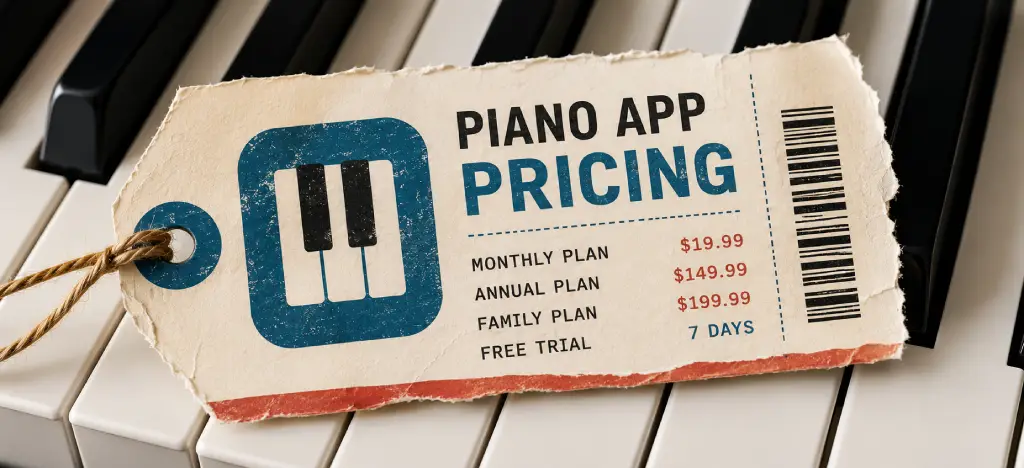
Every piano app promises the same thing, more or less: real songs, fast, without years of scales first. How they get you there differs more than the marketing suggests. Some lean on traditional sheet music, others let you skip reading altogether in favour of falling notes or colour cues. What none of them lead with is the bill. So here it is, using the best available yearly price for each app, as it stands in July 2026.
- Artie pricing
- How much do the most popular piano apps cost?
- Is the cheapest piano app actually the best choice?
- FAQs about piano app pricing
- About the author
Artie pricing
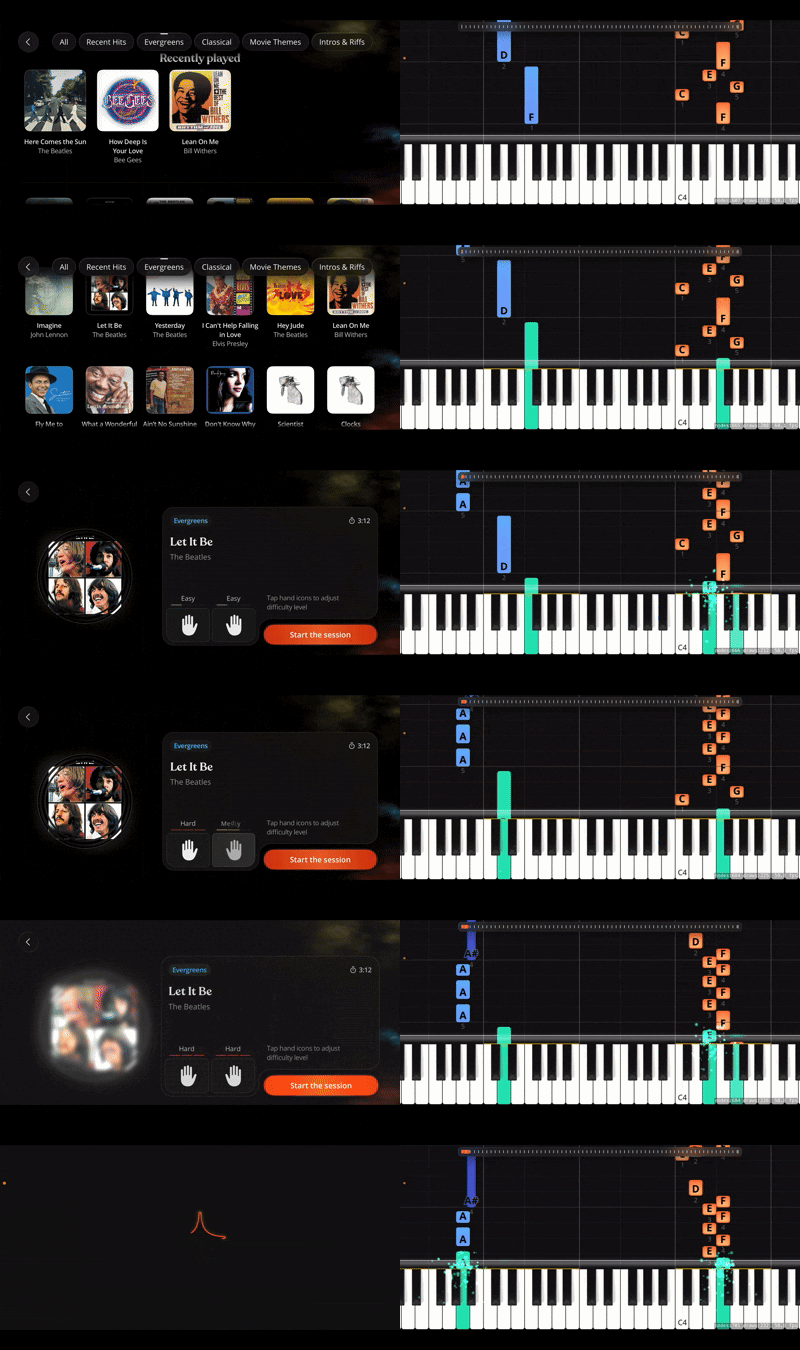
Artie is free to try, with 30-plus songs and no card required. Beyond that:
Standard annual: $149.99, with a 7-day free trial
Voucher annual: $89.99, bought direct from ArtMaster rather than through the App Store.
Family plan (annual): $229.99
The voucher is the number worth remembering. It's not a discount code you have to hunt for, it's simply the better way to buy a year of Artie if you're buying it for yourself.
💡 ARTMASTER TIP: For a proper look at how Artie actually works day to day, read the full Artie piano app review.
How much do the most popular piano apps cost?
App | Yearly | Family plan | Free trial | Feedback method |
|---|---|---|---|---|
$89.99 (ArtMaster voucher) $149.99 (standard) | Yes, $229.99/yr | 7 days | Mic or MIDI, real-time spoken feedback | |
$129.99 | No, group/teacher accounts only | Free tier (Level 1) | MIDI (main), mic on iOS, sight-reading tests (SASR) | |
$119.88 | Yes, $179.88/yr | 7 days | Mic, video of a real pianist's hands | |
$119.99 | Yes | 7 days | Mic, gamified note/timing scoring | |
$149.99 | No | 14 days | Mic, scoring plus 1-on-1 instructor support | |
$149.99 | No | 7 days | MIDI only, no mic-based note detection | |
$169.90 | Yes, $209.90/yr | 14 days | Mic (MIDI optional), note-by-note scoring |
At $89.99, Artie's voucher price is the lowest yearly figure on this list. Flowkey and Yousician come closest, with Piano Marvel a little behind. Skoove, Playground Sessions and Simply Piano all sit higher again. Price aside, here's how each one actually teaches:
Artie: Real-time piano listening with mic or MIDI, spoken feedback, Wait Mode that lets you learn at your own pace, and the ability to add almost any song with a MIDI file.
Flowkey: 1,500-plus songs, video of a real pianist's hands alongside the sheet music.
Piano Marvel: Structured method books and sight-reading tests (SASR), closer to a lesson book than a game. MIDI is the main input, with a newer mic option on iOS. Also lets users upload their own sheet music.
Skoove: Mic-based scoring plus 1-on-1 messaging with a real instructor.
Simply Piano: Mic (MIDI optional), gamified note-by-note scoring aimed more at motivation than technical correction.
Yousician: Same gamified, mic-based approach as Simply Piano, with its own song catalogue.
Playground Sessions: MIDI only, no microphone-based note detection at all, so it won't work on an acoustic piano without a MIDI connection.
Piano Marvel is the other one to watch on the MIDI point. Its main mode still relies on MIDI for sight-reading assessment, though the newer microphone option on iOS is catching up in accuracy.
💡 ARTMASTER TIP: For the longer version of this comparison, including what each app actually feels like to use, see my guide to the best piano learning apps.
Is the cheapest piano app actually the best choice?
Price isn't really the question worth asking first.
Flowkey and Piano Marvel are among the cheapest, but neither one listens to how you're playing and talks back. Flowkey shows you a real pianist's hands, Piano Marvel scores your sight-reading. Artie, Simply Piano and Yousician are built around real-time feedback, which is a different product even when the marketing sounds similar.
Cheapest isn't the same question as best value, and anyone who tells you otherwise is selling something.
FAQs about piano app pricing
Do I need a MIDI keyboard to use any of these apps?
No. Every app here works with a phone or tablet microphone against an acoustic piano or basic keyboard, with two exceptions. Playground Sessions requires a MIDI connection and won't function without one. Piano Marvel's main mode is MIDI-based too, though it now has a microphone option on iOS. A MIDI connection generally improves accuracy across the board, but it's an upgrade, not a requirement, for most of these.
Is Artie's $89.99 voucher a limited-time offer?
It's sold directly by ArtMaster as a standing option, not a flash sale or a code you need to hunt down. It's simply a cheaper way to buy the same 12 months of access than going through the App Store.
Do family plans actually save money?
Where they exist, yes. Artie, Simply Piano, Flowkey and Yousician all offer one, and the per-person cost works out lower than buying separate individual subscriptions. Skoove and Playground Sessions don't offer a family tier at all, and Piano Marvel's multi-account options are built for teachers and groups rather than households.
Which app is cheapest overall?
On yearly price alone, Artie's voucher at $89.99 is the lowest figure in this comparison, with Flowkey and Yousician close behind in the low $120s. Cheapest isn't the same as best fit, though. It depends on whether you want real-time feedback while you play, a video-and-sheet-music library, or a structured sight-reading course.
In short: Piano app subscriptions in 2026 run from around $119 to $170 a year on their standard plans, with Artie's ArtMaster voucher bringing that down to $89.99, the lowest figure in this comparison. None of these apps require a MIDI keyboard to get started, though two (Playground Sessions and Piano Marvel's main mode) do require one for full functionality. Family plans are available on four of the seven and typically work out cheaper per person than individual subscriptions.
📌 Prices pulled from official app store listings and provider sites, July 2026. Regional pricing and app store A/B testing mean two people can see two different numbers for the same plan, so check before you publish anything as gospel.
About the author
Matt Ford is a musician, writer and father based in Prague. He writes about music learning, creativity and technology for ArtMaster.