Most people do not quit music because they lack talent. They quit because the beginning feels awful and badly designed.
I know, because I have done it myself. At one point, I learnt a few chords on acoustic guitar, got just far enough to feel like I had technically started, and then gave up. Not because I made some grand decision that guitar was not for me. I just stopped picking it up. The guitar stayed where it was. The habit never became a habit.
And I think that is how it happens for a lot of people.
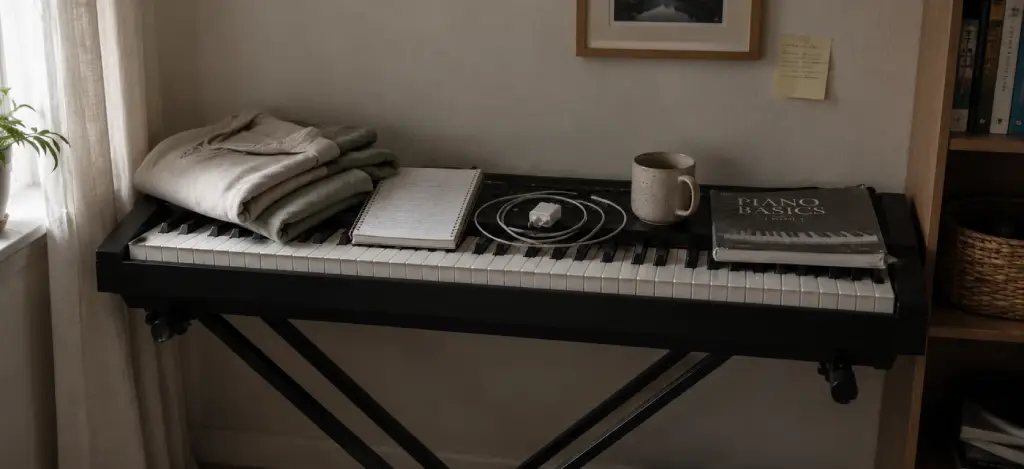
Think about how many guitars are gathering dust in spare rooms right now, or how many keyboards were set up once and have mostly served as a shelf since. How many people downloaded a guitar or piano app, watched a video, had a go for twenty minutes, and then quietly never opened it again?
- Nobody tells you what to actually do
- You can't tell if you're improving
- Every wrong note becomes evidence
- The fix isn't more content
- The first month was never the test
- FAQs: The first month of learning an instrument
Almost none of those people sit down one day and conclude, “I am untalented.” It happens more gradually than that. Somewhere in the first few weeks, the instrument stops feeling like a possibility and starts feeling like evidence. Evidence that your hands are wrong, your timing is wrong, your brain is too slow, or that other people just have something you do not.
That window, roughly the first month, is where a lot of people fall away. Not because the instrument turned out to be too hard, and not because they were uniquely bad at it, but because the beginning of learning music can be confusing, lonely, and weirdly unforgiving. Especially if nobody is helping you understand what is normal, what is progress, and what is just the unavoidable sound of being new at something.
Nobody tells you what to actually do
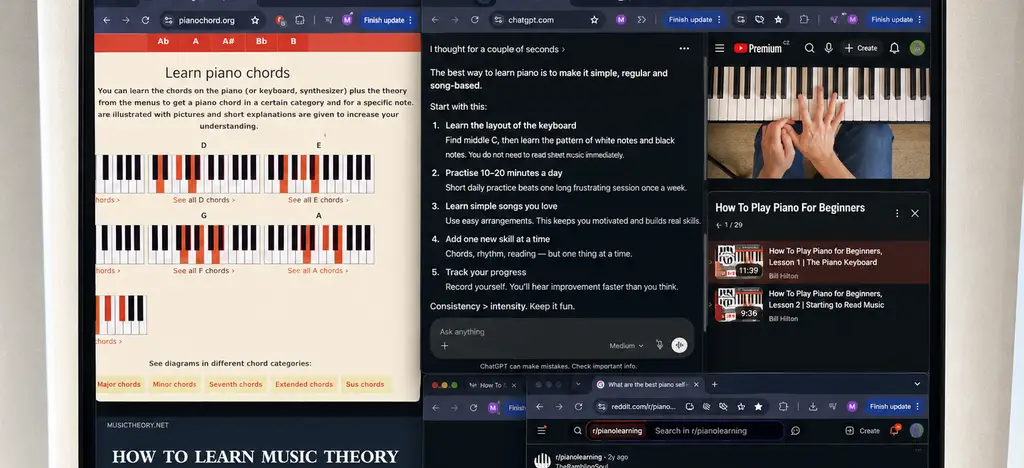 The first problem is that a beginner has, technically, an enormous number of options and no real way of choosing between them. You could learn a scale, learn a chord, try to play a song you actually like, watch a tutorial someone recommended, or have a go at all four in the same twenty-minute session and come away slightly worse at each of them than when you sat down.
It's not that beginners aren't putting in effort. It's that nothing has told them what the effort should be aimed at.
With most things people learn, there's some kind of sequence to follow: a syllabus, a course with units, a test with a known shape. Learning an instrument on your own, with a few apps and whatever YouTube happens to suggest, doesn't really work like that. There's just an enormous amount of material out there, and very little indication of which bit of it is for you, today, given where you actually are.
So people guess. They pick the song they want to play, even though it's well beyond them, or they pick something so simple it bores them within a week. And either way they come away with the sense that the instrument itself was the problem. When really it was more that the first month became a string of slightly random decisions, made without any information about whether they were the right ones.
💡 ARTMASTER TIP: If you're starting piano and want less guesswork in those first few weeks, the best ways to learn piano: a practical guide for beginners is a good place to work out what your next step should actually be. Or try one of our beginner courses here.
You can't tell if you're improving
 The second problem is quieter, and might matter more in the long run.
Most skills give you some kind of signal as you go. You run, and your time changes. You cook something, and it either tastes better than last time or it does not. You write something, read it back a week later, and can usually tell, in some rough way, whether it has improved.
Music is much less generous with that feedback, especially early on.
A beginner playing a simple piece on day three sounds, to their own ear, almost exactly like the same person playing the same piece on day twenty. The improvements are real. Timing tightens slightly. Fingers find positions a little quicker. The brain starts anticipating what is coming. The pauses get shorter. The panic fades by a few degrees.
But those changes are small, and they are happening underneath a layer of sound that still sounds, broadly, like someone who is learning an instrument.
This is one of the strangest things about learning music. You can be improving and still sound bad. In fact, for a while, that is exactly what happens. You are better than last week, but not good enough for your own ears to believe it.
So the practice does not feel like it is doing anything.
And when something does not feel like it is working, the conclusion most people reach is not, “This just takes longer than I assumed.” It is closer to, “I must not be very good at this.” Not because that is a fair reading of the situation, but because it is the only reading available when nothing else is telling them otherwise.
This is part of why feedback matters so much — something like Artie, our AI Piano Teacher can pick up on small changes in timing, accuracy and practice behaviour before they are obvious to the player. That matters because beginners often need proof that something is changing before they feel motivated to keep going.
Every wrong note becomes evidence
 Put those two things together and you get the actual shape of the problem.
With no clear idea of what to do next, and no real sense of whether any of it is working, a wrong note stops being just a wrong note. It becomes a small piece of evidence in a case that is quietly assembling itself in the background.
Maybe I am one of those people who is not musical.
Maybe other people just pick this up and I do not.
Maybe I left it too late.
None of that needs to be true to be convincing. It just needs to keep happening, day after day, with nothing around to interrupt it or offer a different explanation. Which is roughly how the idea that some people just “are not musical” takes hold in the first place.
This is probably why so many adults who “tried piano as a kid and were rubbish” never go near a keyboard again. Not because they were uniquely rubbish, but because nobody at the time gave them any reason to think the rubbishness was a phase rather than a verdict.
The strange thing is that early music learning almost always sounds bad. It is supposed to. Your hands are doing unfamiliar things. Your ears are trying to process timing, pitch and rhythm at once. Your brain is dealing with symbols, patterns, movement and sound, all in real time. Of course it feels clumsy.
But when nobody explains that, clumsy starts to feel like a personality trait.
That is the dangerous bit.
💡 ARTMASTER TIP: Did you know that even a few scrappy minutes of practice a day can start changing memory, focus and mood — long before any of it shows up in how you play? Find out more about what learning music does for your brain and body.
The fix isn't more content
If the first-month problem really were about talent, there wouldn't be much to be done — you can't give someone an ear they don't have, or hands they weren't born with.
But the problem, as it actually plays out, looks more like three fairly ordinary things missing at once: no clear sense of what to practise today and why, no useful feedback on whether yesterday's effort did anything, and nothing to keep someone going on the days when frustration would normally win. None of those require talent to fix. They're closer to design problems than personal ones.
Structure means having some sense of the next small thing to work on, rather than choosing between four options and picking the wrong one out of habit. Feedback means something — even something small — telling you whether what you just did was a bit closer to right than what you did yesterday. And the third part, getting through frustration, is often where solo attempts fall apart, because frustration with no one watching and nobody expecting you back tomorrow is very easy to walk away from.
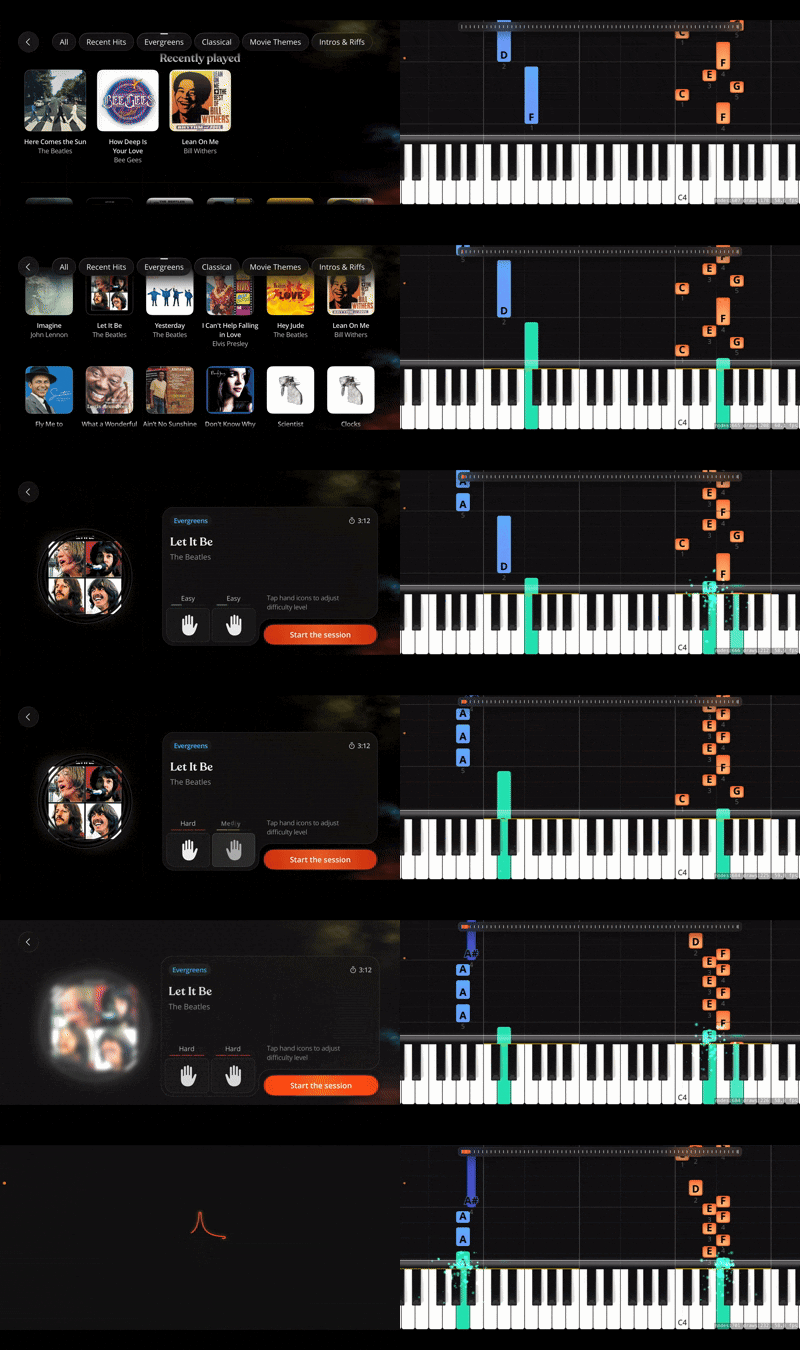
This is roughly the gap that Artie, ArtMaster's AI piano-learning app, is built to sit in. The idea isn't to make the early weeks easier by skipping anything, but to make sure a beginner always has a next step, some sense of whether it's landing, and a reason to come back to a section that isn't going well yet, rather than just closing the lid and quietly deciding not to reopen it.
The first month was never the test
If you've tried an instrument before and it didn't stick, it might be worth going back to that first month — not to ask whether you were any good, but to ask whether you ever really knew what you were supposed to be doing, or whether anything ever told you it was working.
For most people, if they're honest, the answer is no. That's not a verdict on them. It's more a description of how badly that first month tends to be set up for almost everyone who goes through it.
The first month was never a test of whether you're musical. It was just the first month — confusing, slow, and short on feedback, much like the start of most things worth learning. The people who end up sticking with it usually aren't the ones who found it easier. They're the ones who had something — a teacher, a friend, a structure, even just a small nudge — that got them through to month two.
💡 ARTMASTER TIP: If you're looking for that small nudge right now, a good place to start is:
FAQs: The first month of learning an instrument
Why do so many people quit learning an instrument in the first month?
Mostly because the first month gives beginners very little guidance on what to practise and very little feedback on whether it's working. Without either of those, ordinary beginner mistakes start to feel like proof of a lack of talent, rather than what they actually are — the normal early stage of learning anything.
Does struggling in the first month mean I'm not musical?
No. Almost everyone struggles in the first month, including people who go on to play comfortably for years. The struggle is a feature of the early stage, not a measurement of ability.
How can I tell if I'm actually improving as a beginner?
Early progress is often too small to hear clearly on your own, which is part of the problem. Recording short clips a week apart, or using an app that tracks accuracy and timing over time, can make small improvements visible that would otherwise go unnoticed.
What's the best way to get through the first month of learning piano?
Having a clear idea of what to practise next, some form of feedback on how it's going, and a reason to come back the next day — whether that's a teacher, a practice partner, or guided software — tends to matter more in the first month than natural ability.
Can an app really help with this?
It can help with the structural side of things — knowing what to do next and getting some signal on progress — even if it can't replace everything a good teacher offers. Artie, ArtMaster's AI piano-learning app, is built around exactly this gap, giving beginners guided practice, feedback, and a way to keep moving through the early weeks when motivation is hardest to hold onto. If you're curious what that actually looks like in practice, this review of Artie goes into more detail.